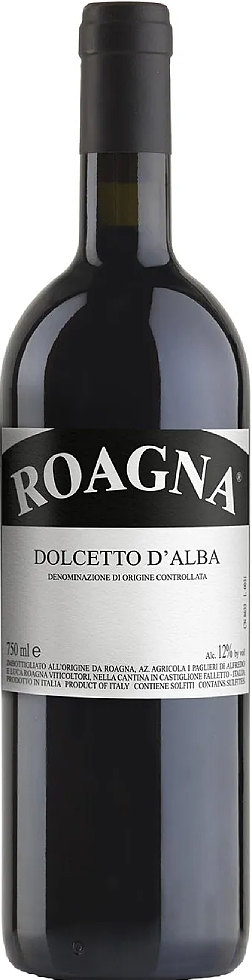
2023 Roagna Dolcetto d’Alba
£30.00
“These are not happy times for Dolcetto, with many vintners today ripping out their vines to replace this grape with Nebbiolo. The Roagna family is determined to keep its two parcels of Dolcetto in Barbaresco. Luca’s grandfather drank Dolcetto every day, and just as he loved it, this wine is made in an old-school style. Fruit comes from 70- and 80-year-old vines. The 2023 Dolcetto d’Alba sees an incredible 100 days of maceration, and the idea is to get as much tannin as possible from the skins and seeds because Dolcetto is not naturally tannic. Winemaking is an infusion with submerged cap. Pump-overs and punch-downs are largely avoided. This gives the wine just enough structure for a modest aging window. Otherwise, you get very pleasurable, crunchy fruit over a mid-weight delivery with delicate tones of rose, violet and cherry cola.”
92 Points, Monica Larner, The Wine Advocate
Order Any 6+ Bottles For Fast FREE Delivery.
Product Description
The fine estate of Roagna has long roots in the commune of Barbaresco, having been started very early in the twentieth century by Vincenzo Roagna. Vincenzo passed on the reigns to his son Giovanni Roagna, who in his turn saw his son Alfredo succeed him as the head of the estate. Today the property is run by Luca Roagna, the fifth generation of the family. Luca was born in 1980 and succeeded in winemaking for the property soon after he graduated from oenological school in 2001. The style of the estate’s wines has been carefully passed down through all five generations of the Roagna family, with the wines made in a very traditional and classic style. These are deep, complex, and structured wines that are built to age and handsomely reward cellaring.
The heart of the Roagna estate is its six and a half hectares of vineyards in the commune of Barbaresco, most of these lying in the cru of Pajè. From the Pajè vineyard, the Roagna family now makes three distinct cuvées, a Barbaresco “normale” labeled as Barbaresco “Pajè,” a Barbaresco Paje Vecchie Vite and “Crichët Pajè” – made from the crest of the Paje cru. In 1989 the family’s long-held aspirations of owning top-level crus in Barolo comparable to their Pajè holdings in Barbaresco came true when they purchased a parcel historically known as La Rocche e La Pira, in the fabled village of Castiglione Falletto.
Through the 2004 vintage, wines from Pira were labeled as either Barolo “La Rocca e La Pira” or Barolo Riserva “La Rocca e La Pira.” For the 2005, 2007, and 2008 vintages, wines from that vineyard were labeled as “La Pira” or “La Pira Vecchie Vite,” although the fruit has always been sourced from the same vineyard. The label changed again beginning with the release of the 2009 wines – they now have to be labeled with simply “Pira” which is the new official name of the vineyard according to the new disciplinary for the Barolo appellation. There will also sometimes be a Barolo Pira Vecchie Vite selection from the oldest vines in the cru. He will still occasionally release a Riserva selection: a barrel or barrels of the VV held back for additional time in the cellar. For the long-term aging of these special Riserva releases, Luca now ages them in specially made Clayver vessels made of ceramic which are more porous than concrete creating the approximate oxygenation of a barrel albeit in a more neutral vessel. All of Roagna’s cru wines are from vines aged 25-50 years, the VV wines are from vines older than 50 years of age.
Beginning with the 2013 vintage, Luca has started bottling two new wines: a cru Faset wine (from a leased parcel) and a Barolo di Barolo from the Terlo cru in Barolo – from vines owned by his partner, Romina’s family. Starting with the 2014 vintage he debuted two additional wines from leased parcels, one from the famed Barbaresco cru Gallina in Neive and the other from, perhaps Barbaresco’s greatest cru, Albesani.
The vinification techniques at Roagna are still traditional though Luca has made noteworthy improvements and changes to the process. The fermentations are in cask and the macerations have gone from around thirty days to, on average, 60-90 days. The aging regimen depends a bit on the cru and vintage but goes from 2-3 years to sometimes 8-10 and as much as 15-16 years for the Riserva. Luca has also switched all of their oak to the highest quality French oak 10cm thick – twice the thickness of a standard cask. These casks allow for a very slow micro-oxygenation which adds to the elegance of the finished wines.
In addition to their fine Barbaresco and Barolo bottlings, the property also makes a Langhe Rosso cuvée from “younger Nebbiolo vines” which in Luca’s case are under 25 years – hardly young by other producers’ standards. He also produces a chewy and intensely flavored Dolcetto and a white wine that is a blend of 75-80% chardonnay and 20-25% Nebbiolo (vinified without the skins) which they label as Langhe Bianco Solea. The Langhe Bianco Solea is held for three years before release by the winery and is a medium-full, fresh, and pure white that typically offers up an aromatic blend of pear, flowers, a touch of honey, and pastry cream. All of the estate’s wines are bottled unfined and unfiltered.
Roagna’s dolcetto comes from parcels coming out of the estate’s holdings in Paje and Carso. All the fruit is hand harvested and ferments for 10 days with indignenous yeasts started by pied de cuvee, submerged cap maceration then ensues for 90-100 days. Fragrant aromas of crushed roses and violets infused with red fruit tones circle around in the glass. There is a clarity here you don’t see with most dolcetto, and the mouthfeel is always like silk across the plate while red plum and roses linger on the incredibly sapid finish.
Additional Information
| ABV | 13% |
|---|---|
| Bottle Size | Bottle 75cl |
| Colour | Red |
| Country | Italy |
| Critic Score | 92/100 |
| Drink until | 2030 |
| Style | Still |
| Sweetness | Dry |
| Vintage | 2023 |